Monday, January 31, 2011

The Hypocrisy of Empire

Consider the following recent events:
  • The U.S. response to the imprisonment of Liu Xiaobo
  • The U.S. response to the uprising in Egypt
  • The U.S. response to the Wikileaks revelations
In the first case, the U.S. is doing a tolerably good job of defending the principle of freedom of speech. Of course, the speaker in this case is criticizing a U.S. rival, so in now way is he doing anything to upset the interests of the Empire.

In the second case, the Empire has been caught between its rhetoric in support of "democracy" and support for our chosen dictator in this part of the world. As a result, the U.S. response has been weak and ineffectual, and it is hard to imagine that the gap between rhetoric and action will endear Empire to the population of Egypt.

In the third case, because the interests of Empire have been directly attacked (or more accurately, the U.S. hasn't been attacked, Wikileaks has merely been shining a flashlight into dark corners that the government would rather not have investigated), the principle of freedom of speech clearly has no applicability here, at least in the eyes of the Empire.

So, we learn from these examples that the U.S. only supports freedom of speech that is agreeable to the U.S. government. Furthermore, these examples are hardly unique: of hundreds of examples I could choose from, I picked these because they are fairly recent.

I am convinced that even more than thuggish behavior, the thing that most upsets people is hypocrisy, and the Empire is drenched in hypocrisy. Of course, to maintain an Empire, perhaps it is necessary to engage in widescale hypocrisy - otherwise, there would be no justifiable rationale for the Empire.

One way or another, I expect this Empire will eventually collapse. When it does, I hope that whatever nation arises in its place in Cascadia has enough sense and humility to deal with the world honestly, so that even if not powerful, it is a nation that can be respected.

Friday, January 28, 2011

High Speed Rail in Cascadia?

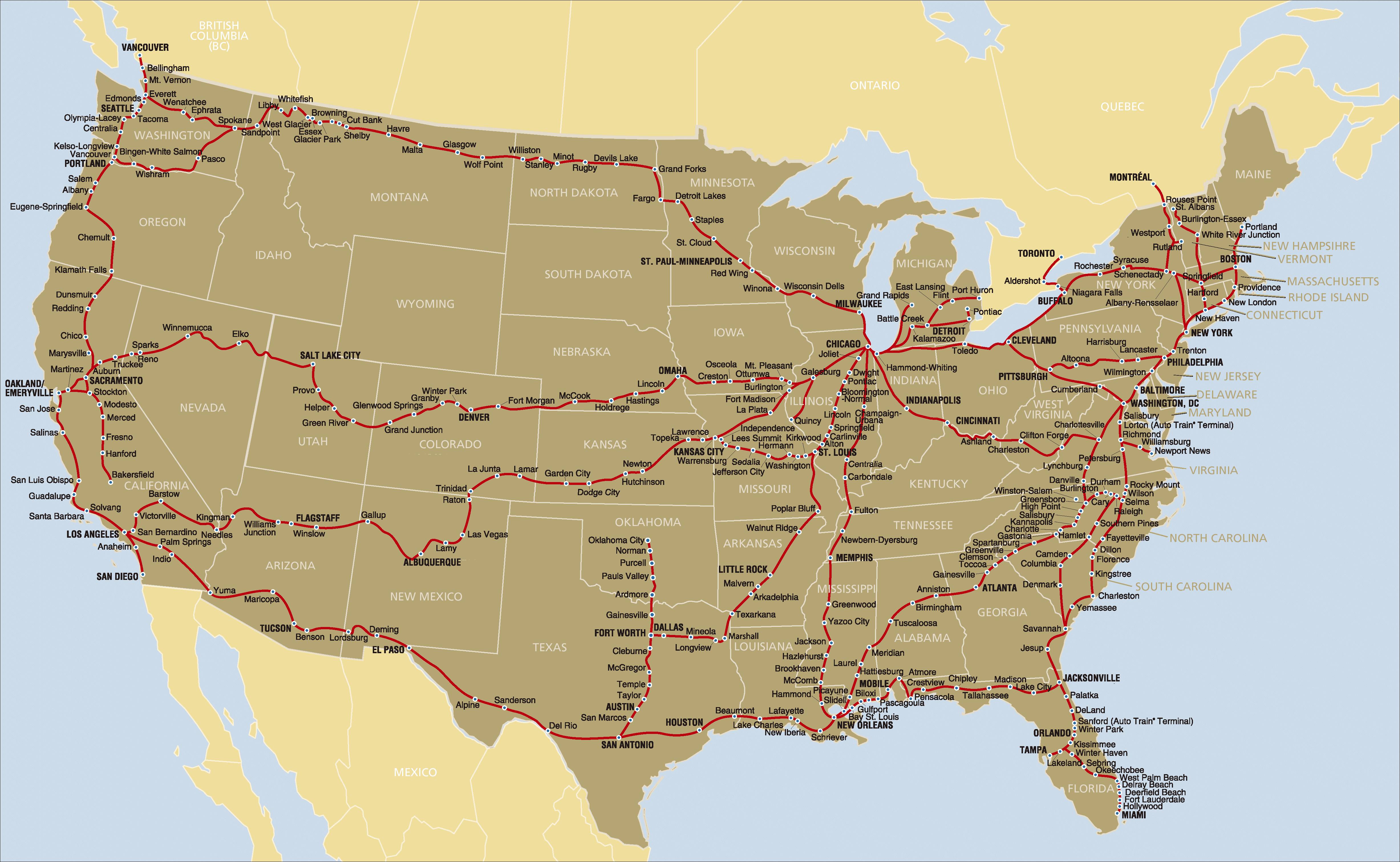
I recently ran across a Facebook page for "High-Speed Rail for Washington, USA". Frankly, this seems to be rather a pie-in-the-sky goal. At least they are focusing on the right goal - get people out of cars and airplanes and into a much more efficient and environmentally friendly mode of transportation. However, we don't even have passenger rail of any sort throughout huge swathes of Cascadia! Take a look at this Amtrak system map. Amtrak won't get you within 100 miles of Yakima, which has a population of 85,000 people and is the 10th largest city in Washington. Amtrak doesn't even get within 200 miles of Boise, Idaho's capital and largest city (and that's via Nevada, not even a part of Cascadia).

As we enter the Long Emergency of declining energy supplies, passenger rail service may be the only viable means of overland transport outside of riding a horse or walking. Huge areas of Cascadia may really suffer if we don't make an effort to build a passenger rail system that is at least up to third-world standards before it is too late. Let's lay off the dreams of a high-speed rail system in some never-to-come Techno-Utopia, and instead concentrate on building something that will meet the needs of real people in the real future we are likely to experience.

Wednesday, January 5, 2011

Cascadian Independence

As things continue to deteriorate around the world and at home, the case for us in Cascadia to get off the train of Empire gets stronger and stronger. Here are some links to groups that are working toward this goal:
At the present, none of these initiatives seems likely to gain much of a following, but as the collapse of the Empire proceeds, hopefully ways to proactively and peacefully obtain Cascadian independence will begin to gather momentum.

Thursday, December 9, 2010

Shaping the Collapse of the Empire

One of my starting assumptions when thinking about the future is that the collapse of industrial civilization is inevitable. Occasionally, there is a debate among Peak Oil aware circles about whether we are facing a quick collapse or a slow, grinding, long collapse. (There are some who say that Peak Oil does not equal collapse in our present context, but they can be safely ignored.) The question I propose to address here is: if we could choose, what sort of collapse would be most desirable (or, more accurately, least awful)?

There are some who argue that a slow collapse would be better, because it could mitigate some suffering, allow us to prepare for a better social organization post-collapse, etc. The problem I see with this point of view is that is presumes that we will retain a reasonable political order all the way down the collapse curve. However, it seems more likely that we will face political turmoil and potential collapse earlier rather than later in this process. The history of the Great Depression in Europe, and particularly in Germany, is instructive in this regard. What arises may almost certainly be, in some form, a malignant political order that does not respond well to the efforts of individuals who are outside the systems of power to effect positive change.

On the other hand, a quick collapse, while distinctly unpleasant, at least has the virtue of taking out more of the systems of state power before they can be used in bad ways against the populace. It also will probably be better for ecological systems, in that the ruthless exploitation that industrial civilization practices will come to an end sooner than it would in a slow collapse. If we all become poor relatively quickly, there will certainly be violence, injustice, and hardship, but that will be more manageable if most state power has collapsed as well, rather than if we continue to extend and pretend in a way that props up, as much as possible, industrial civilization and state power turns into something diabolical.

Having established that I would prefer a fast collapse to a slow collapse, what, if anything, can individuals ethically do to bring this preferred option about? Here are some of the ideas I have:
  • Shine a spotlight, using all available means, on the nature and abuses of Imperial power, so that ones friends and neighbors understand why it is crucial to withdraw their support. As Wikileaks is proving, daylight is the mortal enemy of Empire.
  • Discharge all indebtedness - preferably by paying it down and not incurring new debt, but default may be acceptable as well. The Empire's economic system relies on indebtedness and interest payments to function. In conjunction with this, find ways to preserve your assets outside the banking (and credit union) system.
  • Withdraw, to the maximum extent possible, from the money economy.
  • Find your life's purpose and meaning in something besides materialism.
I do not advocate for violent resistance to the empire, because by pursuing violence, we would simply turn ourselves into that which we claim to oppose.

Monday, December 6, 2010

Not a Good Week to be Poor

Of course, there never is a good time to be poor.

But in the past week we have Holidays about survival as jobless benefits end:
Congressional opponents of extending the benefits beyond this month say fiscal responsibility should come first. Republicans in the House and Senate, along with a handful of conservative Democrats, say they're open to extending benefits, but not if it means adding to the $13.8 trillion national debt.
But apparently unfunded tax cuts for those earning millions annually are an acceptable reason to add to the deficit.

And in Olympia, the nominally democratic governor is proposing elimination of the state's Basic Health Plan, which exists to serve those who otherwise simply won't have health coverage.

Apparently there are a whole lot of people currently in politics who think that Hoover had the right ideas in 1931.

ETA: Apparently the Congress and the President have reached an agreement to extend both unemployment benefits (for people who desperately need them) and tax cuts for the top 2% (definitely not needed).